Why Long-Term Flood Mitigation is a National Issue
At this year’s annual Mayor’s Luncheon, Mayor Siemens explained how flooding in Sumas Prairie threatens critical federal and privately owned infrastructure including Highway 1, the Trans Mountain Pipeline, the Westcoast Energy natural gas pipeline, the Sumas/Huntingdon Border Crossing and Southern Railway service.
Sumas Prairie is home not only to Canada’s most productive farmland, it houses critical trade, transportation and energy infrastructure that is nationally and internationally important- and much of it remains unprotected without long-term flood mitigation in place.
Nooksack Overflow Flood Overview
Sumas Prairie is a 90 square-kilometre area of low-lying, highly productive agricultural land in East Abbotsford. It is home to many multi-generational farming operations that produce approximately half of BC’s dairy, chickens, turkeys and eggs, making it a critical part of the provincial food supply. Critical infrastructure with provincial and national significance, such as hydro transmission lines, energy pipelines, rail lines and fibre optics also run through the Sumas Prairie providing much needed service connections.
Due to its topography and location in a low-lying area, coupled with the fact that it is subject to the risk of Nooksack River overflow, Sumas Prairie has a long history of flooding. During periods of heavy rainfall or rapid snowmelt, the Nooksack River can overtop its banks at Everson, with overflow waters flowing north across the Canada-U.S. border and into Sumas Prairie. This cross-border overflow has resulted in major flooding events, most notably in 1990, 2021 and again in 2025, inundating farmland, infrastructure and residential areas, and prompting large-scale evacuations, loss of farm animals and operations, and extensive clean up, recovery and rebuilding.
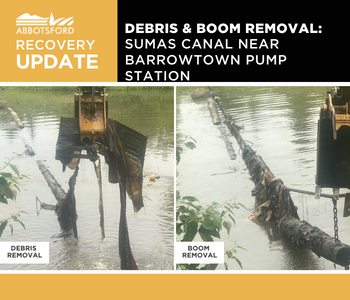
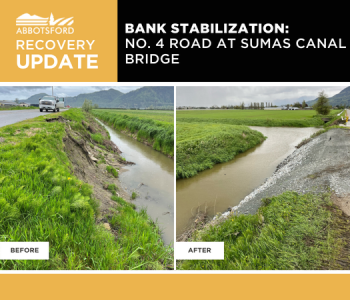
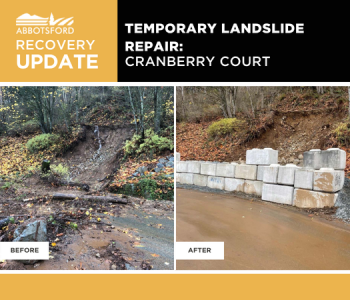
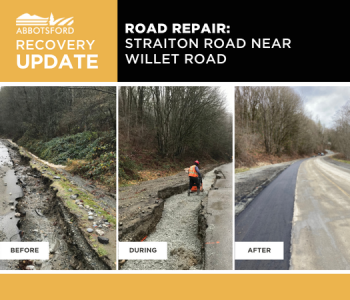
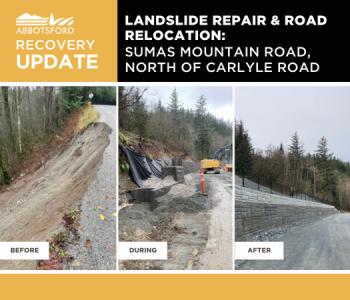
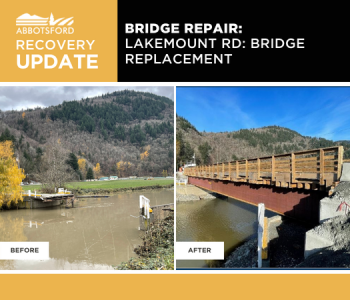
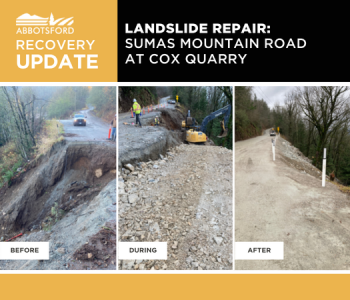
Recovery from the 2021 flood, including the repair and rebuilding of City infrastructure, was a lengthy and expensive process, and was still not fully complete when the 2025 flood occurred. This underscores just how long, costly and resource-intensive flood recovery can be. This reality, along with the need to protect our residents, businesses, farms, the region’s main transportation corridor and the provincial food supply, is why long-term flood mitigation is so critical.
Long-Term Flood Mitigation
Following the 2021 flood, the City of Abbotsford contracted Kerr Wood Leidal Associates Ltd., a renowned consulting engineering firm specializing in water infrastructure, to conduct a full post-flooding analysis of Sumas Prairie with a specific view of ensuring flood protection for existing First Nations communities, businesses, residents and agricultural properties. This work is the foundation behind the City’s Long-Term Flood Mitigation Plan.
December 2025 Flood Event
In December 2025, prolonged heavy rainfall caused the Nooksack River in Washington State to once again overtop its banks, sending floodwater north, across the border and into Sumas Prairie.
As a result, 485 properties were placed under Evacuation Order and 1,069 under Evacuation Alert. While the volume of water and overall impacts were less severe than in 2021, this event still had significant consequences. Families were displaced, properties were damaged, farm animals were lost and a vital section of our Province’s key transportation corridor, Highway 1, was closed for three days.
Emergencies like this place an immense strain on the community. This repeat flooding emphasizes the need to continue advocating to senior government for long-term flood mitigation funding, as our residents, farms and livestock, provincial food security and provincial economy were once again put at risk.
The December 2025 was a 1:35 year event
November 2021 Flood Event
In November 2021, Abbotsford experienced one of Canada’s largest flooding disasters when the Nooksack River overflowed and breached its dike and floodwater headed straight to Abbotsford, flooding Sumas Prairie. This event forced the closure of the US/Canada Border and Highway 1, effectively stopping the flow of people, goods and services and led to a significant loss of livestock and poultry, as well as the evacuation of over 1,100 properties and over 3,300 people from their homes.
Response and Recovery work began right away and has continued steadily since the floodwaters receded. The City of Abbotsford has developed a long-term flood mitigation plan for Sumas Prairie on how best to manage the impact of future floods to properties and reduce the risk of repeating the devastation experienced in 2021.
The November 2021 flood was a 1:100 year event.